JackonLux / Outdoor Lighting Guide
Solar Pendant Lights:
Where They Work and What to Check
A practical guide to choosing the right location, checking panel sunlight and planning overhead lighting for patios, sheds and covered spaces.
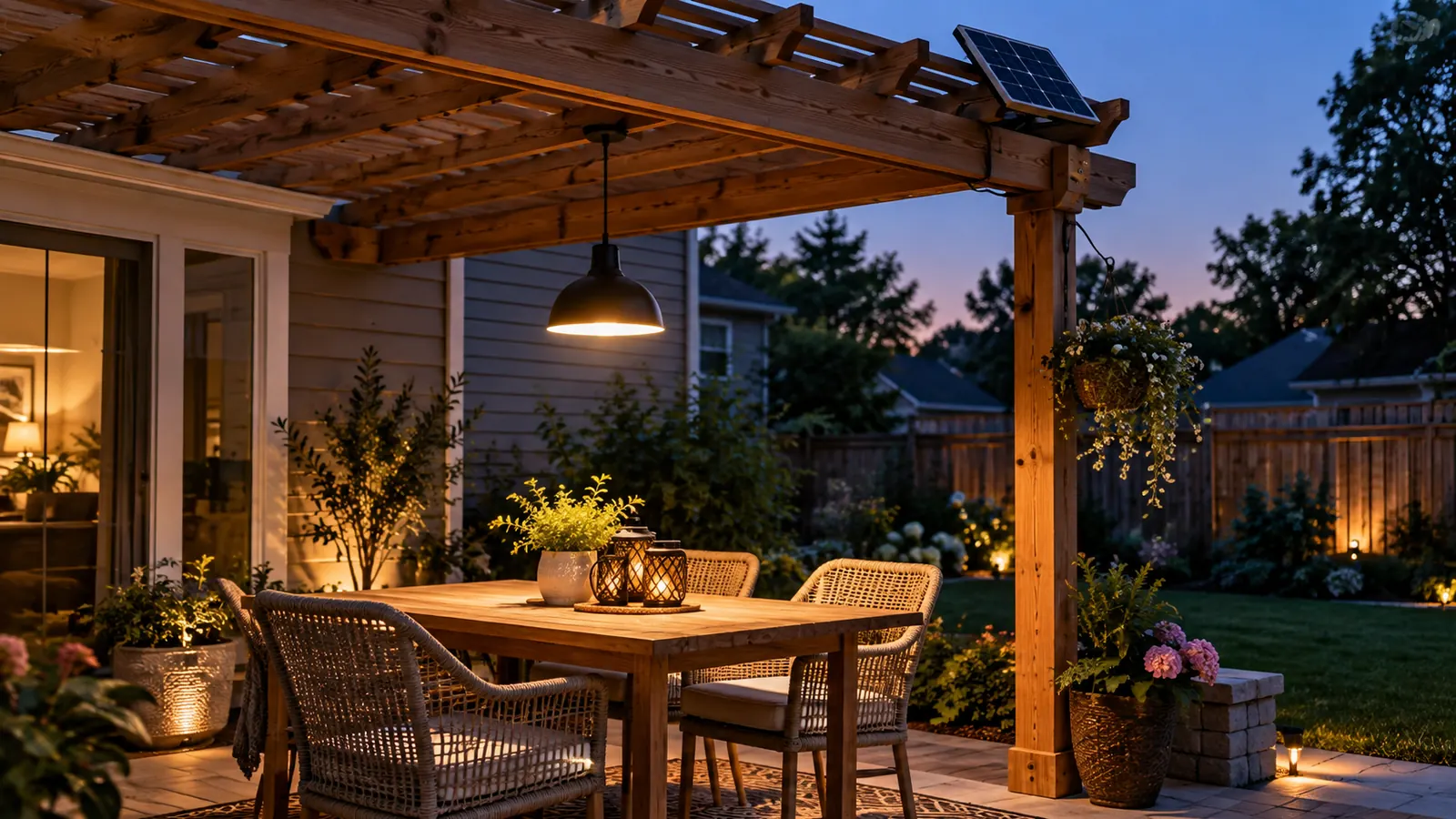
Solar pendant lights can provide useful overhead illumination without adding a new electrical circuit—but only when the panel receives enough daylight, the fixture suits its environment, and the mounting location works for both the light and its cable.
A solar pendant is a reasonable choice for a covered patio, pergola, gazebo, or shed when a compatible panel can charge in a suitable location and the light can be secured over the activity area. Check exposure ratings, cable length, mounting instructions, brightness and battery behavior before choosing the style.
When does a solar pendant light make sense?
Think about the task first. Do you want to see your dinner clearly at a small patio table, find supplies in a shed, or create a soft glow above a seating area? The right answer depends on the size of the area, the amount of illumination needed and how long you expect the fixture to operate after dark.
Most small consumer solar lighting products use a photovoltaic panel to collect daylight and charge a rechargeable battery. The stored energy powers the light later, although the exact controls, charging behavior and runtime vary by design. A solar pendant is not the same as a hardwired outdoor fixture with a continuous electricity supply.
Find a location for the lamp and a separate location for the panel if the design requires one.
Compare the actual product’s permitted weather conditions with the space where it will hang.
Choose a control mode and light level that fit how you use the space after sunset.
Where can solar pendant lights work best?
A defined, sheltered area is often easier to plan than an open yard. A table, reading chair or workbench gives you a clear place for the pendant; a nearby sunny roof edge or other manufacturer-approved surface may provide a panel location.
| Location | Potential benefit | Most important check |
|---|---|---|
| Covered patio | Overhead light for dining or seating | Can the panel receive adequate daylight outside the shade? |
| Open pergola | Focused illumination above a table | Weather exposure, secure attachment and cable protection |
| Gazebo | Comfortable light in a defined space | Roof material, panel position and allowed suspension point |
| Small shed | Convenient light where wiring is impractical | Panel access to daylight and safe cable routing |
| Deeply shaded porch | Possible only with a suitable remote panel location | Whether a reachable sunny location actually exists |
Decorative solar lighting should not be treated as guaranteed security lighting, an approved emergency-lighting system, or a substitute for required code-compliant lighting. Use the right fixture for the safety function the space needs.
Place the solar panel before choosing the pendant position
The light may look best centered over the dining table, while the panel may need to sit several feet away in a more exposed location. That is not necessarily a problem when the product is specifically designed with a separate panel—but you must verify the cable and mounting method supplied with that model.
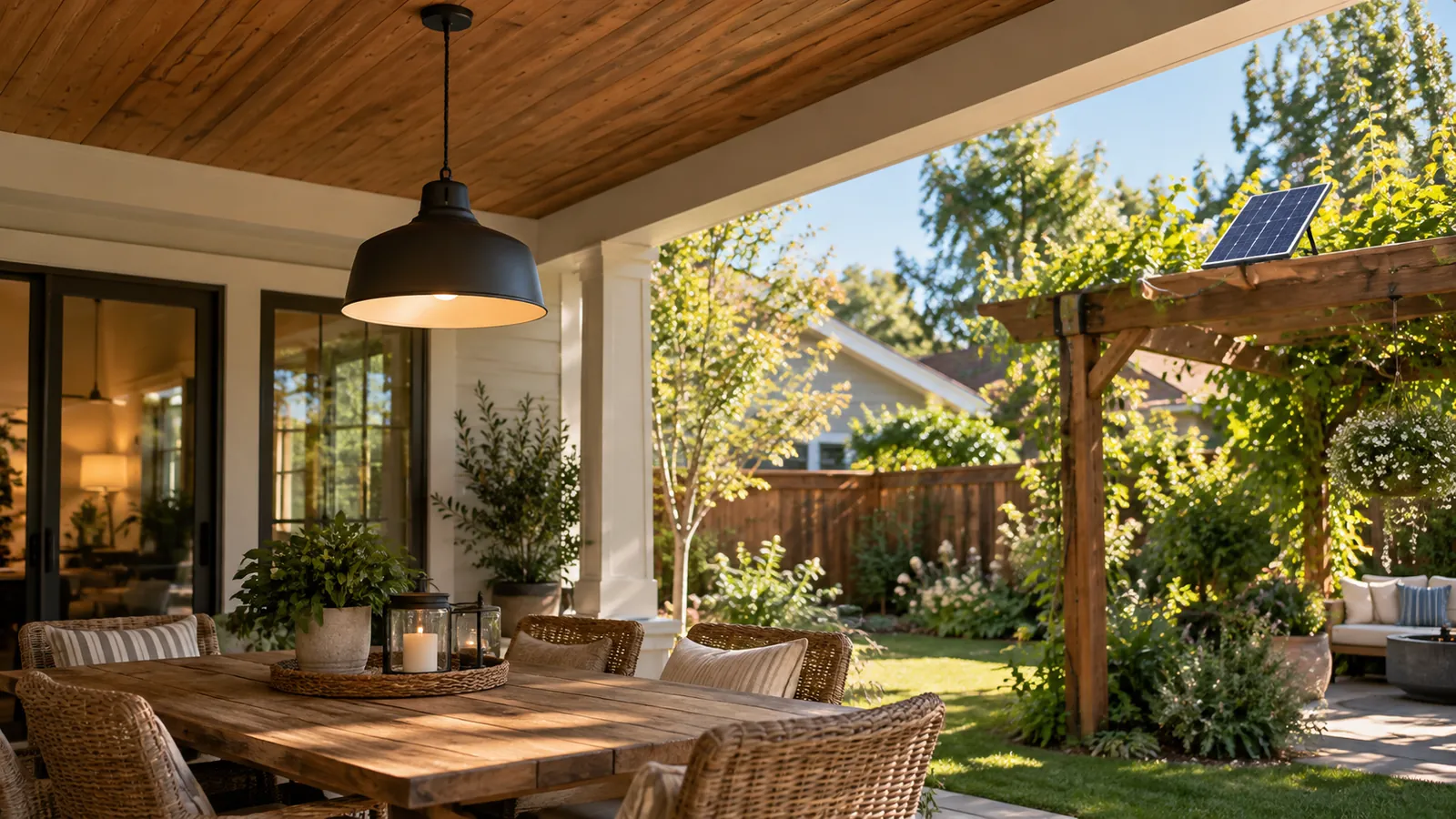
Look at the proposed panel location at different times of day. Shade from trees, neighboring buildings, roof edges and fences changes with the season. The U.S. Department of Energy explains that the output of solar photovoltaic systems depends partly on shade, dirt and temperature. That principle matters for small panels too, but it does not predict the runtime of any specific consumer lamp.
Three checks for panel placement
- Daily exposure: Is the panel likely to receive the kind of light specified in its manual, rather than sitting under an opaque roof?
- Mounting approval: Does the manufacturer permit the proposed orientation and mounting surface?
- Reach: Does the original cable reach the pendant without an unsupported extension or improvised splice?
Measure the cable route and choose a secure suspension point
Measure along the actual cable path, not just the straight-line distance from panel to lamp. Account for corners, beams and the route around doors. Keep wiring away from pinching surfaces, sharp edges, moving hardware and walkways, following the manufacturer’s instructions. Never cut, splice or extend a proprietary cable unless the manufacturer expressly allows that configuration.
Choose hardware appropriate to the load and mounting material. A structural joist and a thin decorative trim board are not equivalent supports. If the fixture requires permanent wiring, changes to electrical circuits or unfamiliar mounting work, use a qualified local electrician and follow applicable codes and permit requirements.
How much brightness and runtime should you expect?
A warm pendant may feel pleasant over a small seating area yet be insufficient for detailed work. When comparing products, use lumens to assess stated light output, kelvins for color appearance and the manufacturer’s control information to understand available brightness modes.
Do not assume a published battery runtime is guaranteed every night. Actual operation may change with charging conditions, selected brightness, temperature, the battery’s age and the product’s control mode. If no verified runtime is listed for the exact model, treat it as unknown rather than assuming a generic number of hours.
| Before you buy | Ask this question |
|---|---|
| Light output | What is the stated brightness, and at which setting? |
| Color appearance | Does the specified light color suit dining, relaxing or tasks? |
| Controls | Does it use a switch, remote, timer, sensor or automatic dusk mode? |
| Battery and charging | What are the manufacturer’s conditions for a full charge and stated runtime? |
| Weather suitability | Are the lamp, panel, connectors and accessories rated for the proposed exposure? |
| Package contents | Are the panel, cable, hooks and hardware actually included? |
Solar pendant vs. plug-in outdoor lighting
Neither power source is better for every location. A solar system may avoid the cost and disruption of a new circuit, while a suitable plug-in fixture may be preferable when a weather-appropriate outdoor receptacle is already available and predictable operation matters more than portability. Both types still require proper fixtures, installation methods and exposure ratings.
| Decision factor | Solar pendant | Outdoor plug-in fixture |
|---|---|---|
| Power source | Stored energy from solar charging | Compatible electrical outlet |
| Location flexibility | Depends on panel, cable and sun exposure | Depends on approved cord routing and outlet position |
| After-dark consistency | Influenced by charging and battery condition | Normally powered while the outlet has electricity |
| Maintenance | Panel cleaning, battery condition and mount checks | Fixture, cord, receptacle and connection checks |
| Best use case | Focused lighting away from convenient electrical service | Reliable power where a suitable outdoor connection exists |
Installation and maintenance checklist
- Confirm that the exact light and all connected parts are suitable for the intended location.
- Inspect the chosen support and review the maker’s mounting instructions.
- Place the panel where its documented charging requirements can be met.
- Measure the cable route and protect it as instructed.
- Charge and test the product in accordance with its manual.
- Try each mode at night to check brightness, glare and control behavior.
- Inspect connections, mounts and the panel after weather events as appropriate.
If you rent your home, also review the lease or building rules before drilling into outdoor structures. Our renter-friendly outdoor lighting guide covers other approaches that may work without permanent wiring changes.
Frequently asked questions
Can a solar pendant hang under a covered roof?
Possibly. The pendant can sometimes hang in a sheltered area while a separate compatible panel receives daylight elsewhere. Whether that arrangement is allowed depends on the exact product, cable length and mounting requirements.
Will a solar pendant charge on a cloudy day?
Charging may still occur in lower light, but output and battery replenishment can decrease. The effect depends on the panel, weather and product design, so consult the maker’s guidance rather than assuming a fixed runtime.
Are all solar pendant lights waterproof?
No. Check the actual weather and moisture ratings of the lamp, panel, wiring and connectors. A shaded or covered location does not automatically eliminate moisture exposure.
Can solar pendant lights replace emergency lighting?
Decorative solar pendants should not be assumed to satisfy required emergency-lighting or egress provisions. For general household planning, see the home power outage lighting checklist.
Choose the site first, then the style
A good solar pendant setup starts with two places: where the light belongs and where the panel can charge. Confirm the distance, permitted exposure, hanging support, controls and realistic performance before deciding which design looks best.
To explore currently listed options, visit the JackonLux Solar & Outdoor Lighting collection. Check its current listings carefully: the collection may contain other types of solar fixtures rather than a specific solar pendant model.
Reference: U.S. Department of Energy — Photovoltaic System Design and Energy Yield. Product-specific installation and electrical requirements must always come from the current manufacturer’s instructions and local rules.