How to Lower Lighting Energy Use at Home
Understand what lights actually cost, then make smarter changes room by room.

Cutting lighting waste begins with a simple question: how much power is a light using, and how many hours does it stay on?
The easiest way to reduce home lighting electricity use is to replace inefficient light sources when appropriate, switch off unneeded lights, and light specific tasks instead of an entire room. Before spending money, estimate the current cost using wattage, operating hours and your actual electricity rate. Smart features help only when they reduce unnecessary use.
Calculate what a light actually costs to run
The math is straightforward. Divide the light’s wattage by 1,000, multiply by the hours it runs, then multiply the kilowatt-hours (kWh) by your electricity price per kWh.
Energy used (kWh) = watts × hours ÷ 1,000.
Electricity cost = kWh × electricity rate.
For example, if a 60W lamp runs five hours a day for 30 days, it uses 9 kWh. At an illustrative price of $0.20/kWh, that is $1.80 for the month. A 9W lamp running for the same 150 hours uses 1.35 kWh, or $0.27 at the same example rate. The $1.53 difference assumes the two lamps are useful substitutes in that location; actual light output, purchase price and local utility charges must also be considered.
| Example lamp | Power | 150-hour energy use | Cost at example $0.20/kWh |
|---|---|---|---|
| Older 60W lamp | 60W | 9.00 kWh | $1.80 |
| Lower-wattage LED example | 9W | 1.35 kWh | $0.27 |
| Difference | 51W | 7.65 kWh | $1.53 |
These are arithmetic examples, not measurements of a JackonLux product or a promise of savings. Check the unit and your current utility bill. The DOE bulb guide shows why light output in lumens should also be compared.
Find lights that stay on without helping
Walk around in the evening and notice where lights remain on in unused rooms, entryways, closets or exterior areas. Some people benefit most from a reminder and a reachable wall switch; others may want an occupancy sensor or schedule. Do not install an automatic shutoff where it would create an unsafe dark route for a household member.
The useful measurement is how many operating hours actually disappear, not whether a product is marketed as “smart.” If a sensor constantly activates because of pets or traffic, it may not save as much as expected.
Put useful light closer to the task
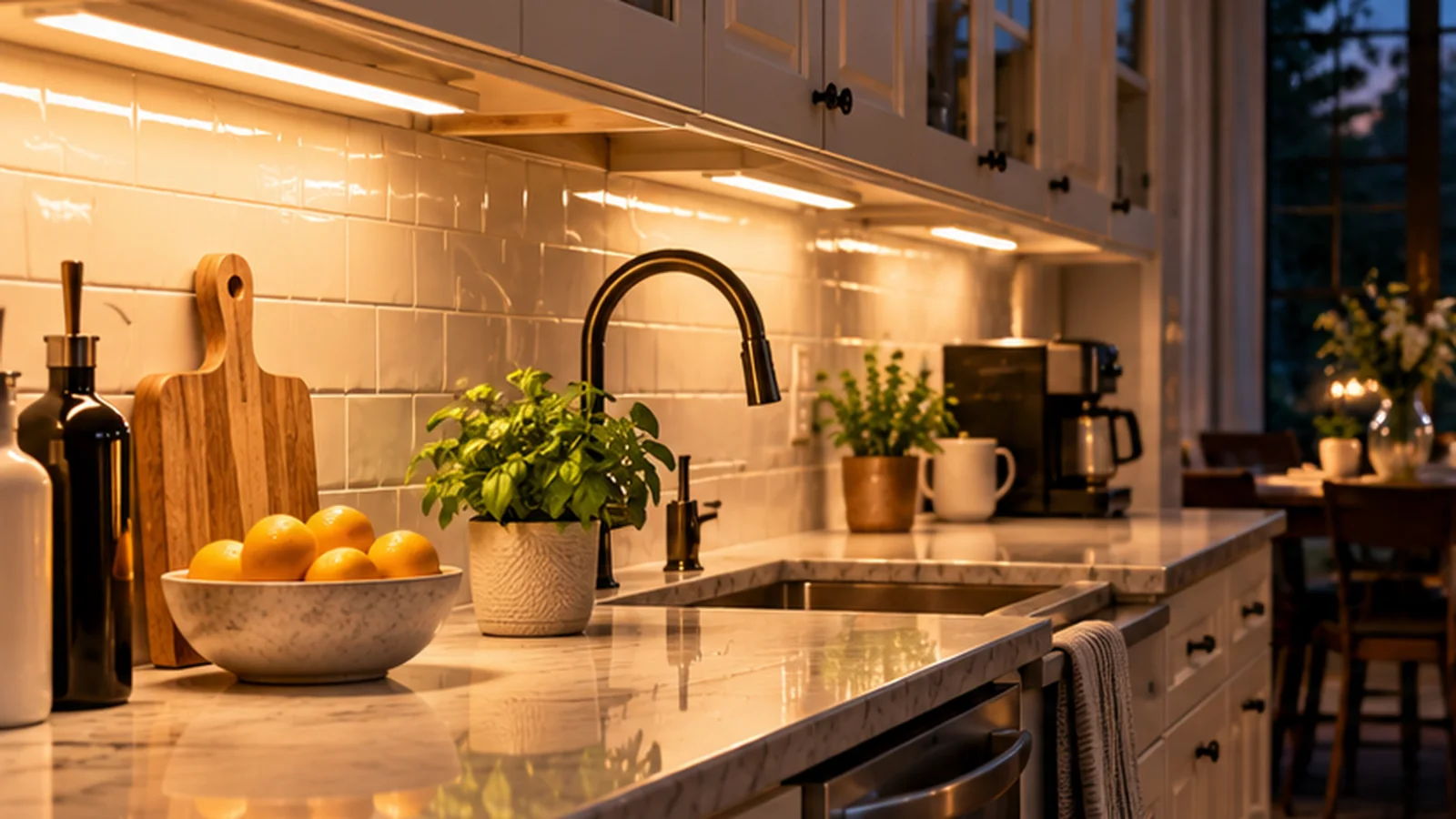
Kitchen under-cabinet lights, a shaded reading lamp and a desk light can help you see a small work area without switching on every ceiling fixture. This is a use-case decision, not a universal promise that all small lights use less energy. Compare the total watts of the lights that would run in each scenario.
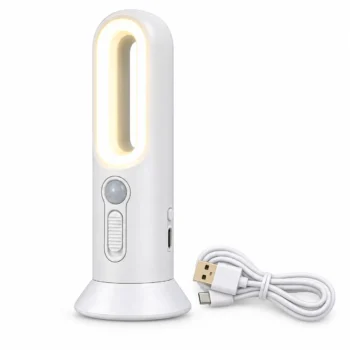
The cabinet and motion lighting range illustrates several mounting and control approaches; check whether any particular model is currently in stock before recommending it to readers.
Are LED strips cheaper to run than ceiling lights?
Sometimes, but a product’s shape does not determine its electricity cost. A 24W strip used for an hour consumes more electricity than one 8W LED downlight used for an hour. Conversely, a small task light may reduce consumption when it replaces several unnecessarily bright ceiling sources during cooking or reading.
Compare total connected wattage, runtime and the amount of useful light at the task. For LED strips, remember that the power supply also has losses; product-label wattage may specify either the strip or the full system. Do not compare watt-per-foot figures with whole-room electricity bills without reconciling the units.
Choose the right kind of lighting control
| Control | Best fit | Limitation |
|---|---|---|
| Manual switch | Regular daily habits | Only works when people remember |
| Motion sensor | Brief closet, pantry or hallway visits | Pets, obstructions or incorrect settings can trigger poor behavior |
| Timer | Predictable exterior or decorative lighting | May need seasonal schedule changes |
| Dimmer | Adjustable lighting in frequently used rooms | Bulb and dimmer must be compatible |
| Daylight-linked control | Spaces with changing useful daylight | Sensors must be positioned and configured correctly |
Energy savings from controls depend on how they are installed and used. DOE discusses occupancy sensors, dimming and daylight controls in its lighting-fixture purchasing guidance.
Read a bulb label without mixing up units
Lumens measure visible output; watts measure electric power; kelvins describe the appearance of white light. Use the DOE lamp comparison to understand why different light sources can deliver similar output at different power levels. Make sure replacements fit the bulb base and fixture size, and are approved for any dimmer or enclosed location.
A rechargeable light is not automatically an energy-saving light: charging losses, standby consumption and running time matter. Solar outdoor lighting may avoid some grid lighting where sufficient sunlight is available, but batteries and panels introduce other trade-offs. A good comparison counts the entire system and its intended purpose.
A practical seven-day audit
- List the fixtures you use most often and record their labeled watts.
- Estimate typical daily operating hours, rather than assuming every light runs all day.
- Identify one high-usage location where a replacement or behavior change is realistic.
- Check whether a local utility rate makes the savings meaningful.
- Verify that a replacement gives enough light, fits the fixture, and works with existing controls.
- Test the revised setup for comfort, glare and safety.
- Recalculate and compare the estimate after one normal week.
Frequently asked questions
Does turning an LED light on and off waste more electricity than leaving it on?
For ordinary household use, turning off an unneeded light avoids energy consumption during the off period. Choose controls that suit the product instructions and the household’s safety needs.
Does dimming an LED always save the same percentage of energy?
No. Actual power response varies with the lamp, driver and dimming equipment. Do not assume a fixed percentage without product-level measurements.
Should I replace every bulb immediately?
Not necessarily. Start with the lights used most often or places where the current setup provides poor light for the electricity it uses. Consider purchase and disposal costs as well as monthly energy use.
Focus on useful illumination, not just lower numbers
The best lighting upgrade produces enough light in the right place, at the right time, while avoiding electricity spent on empty spaces. For a room-by-room planning method, see the JackonLux home lighting guide.
Further reading: DOE – Purchasing Energy-Efficient Light Bulbs; DOE – Purchasing Energy-Efficient Light Fixtures.